SLO County Market Update & Article on Super El Niño
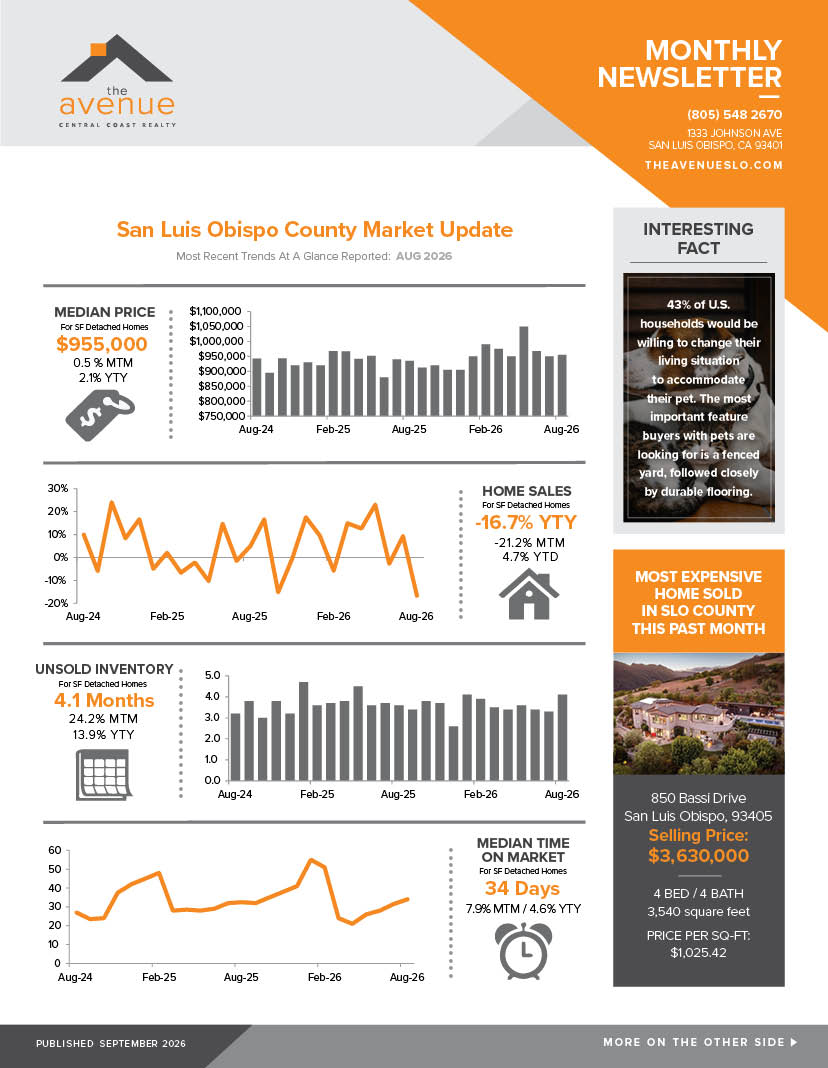
*INTERESTING FACT –
43% of U.S. households would be willing to change their living situation to accommodate their pet. The most important feature buyers with pets are looking for is a fenced yard, followed closely by durable flooring.
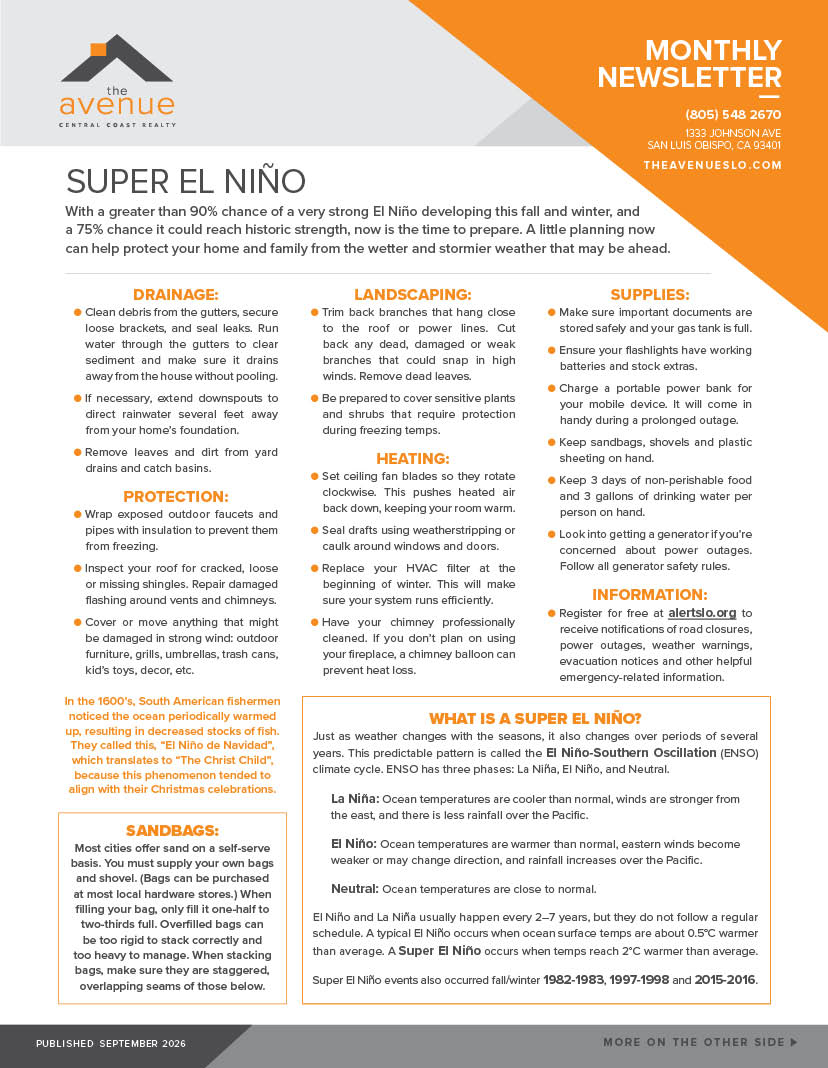
Super El Niño
With a greater than 90% chance of a very strong El Niño developing this fall and winter, and
a 75% chance it could reach historic strength, now is the time to prepare. A little planning now
can help protect your home and family from the wetter and stormier weather that may be ahead.
DRAINAGE:
- Clean debris from the gutters, secure loose brackets, and seal leaks. Run water through the gutters to clear sediment and make sure it drains away from the house without pooling.
- If necessary, extend downspouts to direct rainwater several feet away from your home’s foundation.
- Remove leaves and dirt from yard drains and catch basins.
PROTECTION:
- Wrap exposed outdoor faucets and pipes with insulation to prevent them from freezing.
- Inspect your roof for cracked, loose or missing shingles. Repair damaged flashing around vents and chimneys.
- Cover or move anything that might be damaged in strong wind: outdoor furniture, grills, umbrellas, trash cans, kid’s toys, decor, etc.
LANDSCAPING:
- Trim back branches that hang close to the roof or power lines. Cut back any dead, damaged or weak branches that could snap in high winds. Remove dead leaves.
- Be prepared to cover sensitive plants and shrubs that require protection during freezing temps.
HEATING:
- Set ceiling fan blades so they rotate clockwise. This pushes heated air back down, keeping your room warm.
- Seal drafts using weatherstripping or caulk around windows and doors.
- Replace your HVAC filter at the beginning of winter. This will make sure your system runs efficiently.
- Have your chimney professionally cleaned. If you don’t plan on using your fireplace, a chimney balloon can prevent heat loss.
SUPPLIES:
- Make sure important documents are stored safely and your gas tank is full.
- Ensure your flashlights have working batteries and stock extras.
- Charge a portable power bank for your mobile device. It will come in handy during a prolonged outage.
- Keep sandbags, shovels and plastic sheeting on hand.
- Keep 3 days of non-perishable food and 3 gallons of drinking water per person on hand.
- Look into getting a generator if you’re concerned about power outages. Follow all generator safety rules.
INFORMATION:
Register for free at alertslo.org to receive notifications of road closures, power outages, weather warnings, evacuation notices and other helpful emergency-related information.
In the 1600’s, South American fishermen noticed the ocean periodically warmed up, resulting in decreased stocks of fish. They called this, “El Niño de Navidad”, which translates to “The Christ Child”, because this phenomenon tended to align with their Christmas celebrations.
Sandbags:
Most cities offer sand on a self-serve basis. You must supply your own bags and shovel. (Bags can be purchased at most local hardware stores.) When filling your bag, only fill it one-half to two-thirds full. Overfilled bags can be too rigid to stack correctly and too heavy to manage. When stacking bags, make sure they are staggered, overlapping seams of those below.
WHAT IS A SUPER EL NIÑO?
Just as weather changes with the seasons, it also changes over periods of several years. This predictable pattern is called the El Niño-Southern Oscillation (ENSO) climate cycle. ENSO has three phases: La Niña, El Niño, and Neutral.
- La Niña: Ocean temperatures are cooler than normal, winds are stronger from the east, and there is less rainfall over the Pacific.
- El Niño: Ocean temperatures are warmer than normal, eastern winds become weaker or may change direction, and rainfall increases over the Pacific.
- Neutral: Ocean temperatures are close to normal.
El Niño and La Niña usually happen every 2–7 years, but they do not follow a regular schedule. A typical El Niño occurs when ocean surface temps are about 0.5°C warmer than average. A Super El Niño occurs when temps reach 2°C warmer than average.
Super El Niño events also occurred fall/winter 1982-1983, 1997-1998 and 2015-2016.